Did you mean:
Superposition19 Results for : supposition
-

Jean Buridan's Logic
Jean Buridan's Logic ab 138.99 € als Taschenbuch: The Treatise on Supposition The Treatise on Consequences. Softcover reprint of the original 1st ed. 1985. Aus dem Bereich: Bücher, Taschenbücher, Geist & Wissen,- Shop: hugendubel
- Price: 138.99 EUR excl. shipping
-

Why People Pray: The Universal Power of Prayer , Hörbuch, Digital, ungekürzt, 399min
What is prayer? The question is rather straightforward, but with a bit of consideration, you might find there is no easy answer. In Why People Pray, Rabbi Mordecai Schreiber examines this elusive nature of prayer, as well as the history of formal prayer and how it has been shaped - and continues to be shaped - by an era of unprecedented globalization.At the heart of Why People Pray is that very question: Why do we pray? What is it that compels us to have faith or to give it up? Why do we continue to believe in a higher power in spite of discrimination, conflict, illness, and loss?Rabbi Schreiber’s audiobook introduces a fascinating new supposition: that people of all faiths and all nationalities could conceivably find ways to pray together, using prayers that are universal to all while simultaneously preserving the integrity of each individual faith. He proposes a new approach to prayer in which the spiritual adherents of the world’s religions come together to formulate a universal expression of prayer that does not replace existing creeds, but rather transcends all creeds and gives voice to humanity’s yearning for peace, freedom, and social justice. ungekürzt. Language: English. Narrator: Jason Forbis. Audio sample: https://samples.audible.de/bk/acx0/127322/bk_acx0_127322_sample.mp3. Digital audiobook in aax.- Shop: Audible
- Price: 9.95 EUR excl. shipping
-

Emotional Intelligence: How to Increase Your EQ for Business and Happier Relationships, Increase Your Influence, Improve Your Leadership, Social Skills, Reprogram Your Mindset , Hörbuch, Digital, ungekürzt, 225min
You see, it isn't about graduating top of the class as one who has extreme intelligence could become a failure, even in business, while those people who have moderate intelligence could literally build empires and change the world.But why is this so?Well, that’s where emotional intelligence comes into play...A lot of success has absolutely nothing to do with standard intelligence but rather with what's called Emotional Intelligence (EQ). It can help you to recognize, understand, anticipate, and work with your own emotions and even the emotions of others.Emotional intelligence is a unique ability that can help you to deal with prospects, business associates, employees, customers, vendors, and even contractors.Just imagine you being able to help those people around you feel happy by forseeing their supposition and managing them before they know...wouldn't you be a step ahead?The benefits of emotional intelligence in regards to conducting business are too numerous to name. These include higher levels of intuition, compassion, empathy, and the ability to analyze these emotions successfully. With Emotional Intelligence, you also be able to do the following:Deal better with conflictsSolve problems quickerOffer better servicesListen, understand, and appreciate the people around youControl how you react to challengesStay positive when you make mistakesTrust your business instincts and intuitionConnect with potential partners for your businessBuild better business relationshipsHire the best people for the jobAnd since business is all about relationships, all of these factors can make or break a small business owner's success.Emotional intelligence pertains to the emotional, personal, and social dimensions of intelligence.Emotional intelligence comprises abilities related to understanding oneself and ungekürzt. Language: English. Narrator: Joe Wosik. Audio sample: https://samples.audible.de/bk/acx0/169304/bk_acx0_169304_sample.mp3. Digital audiobook in aax.- Shop: Audible
- Price: 9.95 EUR excl. shipping
-

The Psychopath Factory: How Capitalism Organises Empathy , Hörbuch, Digital, ungekürzt, 313min
Psychopaths seem to be everywhere. They are on the news and at the movies. People who lack empathy, be they ruthless entrepreneurs or crazed spree killers, are frequently labelled psychopathic; the charming socialiser is just as suspect as the awkward antisocial loner. The conception of what defines a psychopath seems to be a morass of contradictions, the only consistency being the supposition of a lack of empathy. The Psychopath Factory: How Capitalism Organises Empathy examines how the requirements, stimuli, affects and environments of work condition our empathy. In some cases work calls for no-empathy characters who don't blink or flinch in the face of danger or crack under pressure. In other cases capitalism requires empathy in spades - charming, friendly, sensitive and listening managers, customer service agents and careers. When workers are required to either ignore their empathy to do a job or dial it up to increase productivity, they are entering a psychopathic modality. The affective blitz of work, flickering screens, emotive content, vibrating alerts and sounding alarms erode our sensitivities whilst we are modulated with attention stimulants, social lubricants and so called antianxiety drugs. This is amidst a virulent and exacerbating climate of competition and frenzied quantification. Capitalism pressures us to feign empathy and leverage social relationships on one hand whilst being cold and pragmatic on the other. We are passionate and enthusiastic whilst keeping a professional distance. Sympathy, care, compassion and altruism are important; The Psychopath Factory: How Capitalism Organises Empathy argues that it is a mistake to presuppose that empathy can achieve these. Rather than being subject to the late capitalist organisation of our empathy, psychopathy could be a means of escape. ungekürzt. Language: English. Narrator: Barnaby Edwards. Audio sample: https://samples.audible.de/bk/adbl/029566/bk_adbl_029566_sample.mp3. Digital audiobook in aax.- Shop: Audible
- Price: 9.95 EUR excl. shipping
-

Emotional Intelligence for Kids: How to Raise an Emotionally Intelligent Child, Enrich the Bonds Between Parent and Child, Contribute to the Development of a Generation of Emotionally Healthy Adults , Hörbuch, Digital, ungekürzt, 324min
We are all born with the power to sense emotions in others. It may be a basic survival skill for humans and animals. This ability usually subsides in childhood as we learn to focus more on verbal cues than emotional ones.Emotional intelligence is one of the foremost fundamental skills your kids need. It is a unique ability that can help your children relate with their friends and older adults better. Just imagine your kid being able to help those people around them feel happy by foreseeing their supposition and managing them before they know. Wouldn't they be a step ahead?Emotional intelligence pertains to the emotional, personal, and social dimensions of intelligence. It comprises abilities related to understanding oneself and others, relating to people, adapting to changing environmental demands, and managing emotions.The good news is you can teach your child to develop emotional intelligence.In this special guide Emotional Intelligence for Kids, you will learn how to raise an emotionally intelligent child, enrich the bonds between you and your child, and most importantly, contribute immensely to the development of a generation of emotionally healthy adults.Highlighted below is a breakdown of what to expect:Understanding emotional intelligence in childrenLearning why emotional intelligence is vital for teenagers Identifying the early signs of giftedness Nurturing creativity in creative kids Raising thinkersHelping your child build emotional and social skillsHandling your child's emotional crises with emotional freedom technique (EFT)Raising successful, generous, responsible childrenExercising to make your kids smarter Knowing memory techniques for teenagers to increase their mental intelligence And so much more...Also, you will discover how you can teach your children to handle their feelings, ungekürzt. Language: English. Narrator: Sara Spadacene. Audio sample: https://samples.audible.de/bk/acx0/231614/bk_acx0_231614_sample.mp3. Digital audiobook in aax.- Shop: Audible
- Price: 9.95 EUR excl. shipping
-

Sex Position, Sex Talk, and Fetishes: How to Transform Your Sex Life Through Kama Sutra, Tantric Sex and Maximizing Orgasm. Master the Art of Sex , Hörbuch, Digital, ungekürzt, 221min, (USK 18)
When you realize that the vast majority of the Kama Sutra isn't generally sex, it turns out to be much more bizarre once you think a 2,000-year-old content keeps on having this impact on your sexual minds. The first Kama Sutra, as opposed to numerous hot and substantial sex manuals, is a philosophical book that gives experiences into a compensating life and fructuosity. It comes chiefly due to the idea of sex (and intriguing sex positions) as an ordinary and solid piece of life, to the extent sex is a handbook. This is a sex. (While queer sex and non-regularizing sex personalities are in the book, it is a very informative supposition that the peruser's essential sexual relationship is hetero) yet some place down the line (with something other than a little orientalism), the non-sexual parts of the Kama Sutra have been neglected, that is a very hetero-regulating book. Believe it or not, it's not primarily a sex manual. The Kama Sutra, accepted to be composed during the second or third century C.E. by the Hindu Vedic scholar Vatsyayana, is a guide for temperate living, loaded up with aphorisms on the idea of love and the significance of family life. It recounts finding a real existence accomplice and making an agreeable relationship, exploring the difficulties of extramarital connections, adjusting family and obligation and the need to bring home the bacon - just as an assortment of positions for sex. "Sutra" in Sanskrit implies treatise; "Kama" alludes to want, delight or sex. In this way: Treatise on want/pleasure/sex. For Vatsyayana, be that as it may, want/delight/sex holds an unexpected significance in comparison to for us world-weary moderns excessively acquainted with commoditized sex. Want, delight and sex in the Kama Sutra are contextualized, seen as a major aspect of a perspective wherein people move together in human expressions of affection and in families and in bigger systems o ungekürzt. Language: English. Narrator: Brittany St. Arnold. Audio sample: https://samples.audible.de/bk/acx0/184215/bk_acx0_184215_sample.mp3. Digital audiobook in aax.- Shop: Audible
- Price: 9.95 EUR excl. shipping
-

Movement Matters (eBook, ePUB)
Experts translate the latest findings on embodied cognition from neuroscience, psychology, and cognitive science to inform teaching and learning pedagogy. Embodied cognition represents a radical shift in conceptualizing cognitive processes, in which cognition develops through mind-body environmental interaction. If this supposition is correct, then the conventional style of instruction-in which students sit at desks, passively receiving information-needs rethinking. Movement Matters considers the educational implications of an embodied account of cognition, describing the latest research applications from neuroscience, psychology, and cognitive science and demonstrating their relevance for teaching and learning pedagogy. The contributors cover a range of content areas, explaining how the principles of embodied cognition can be applied in classroom settings. After a discussion of the philosophical and theoretical underpinnings of embodied cognition, contributors describe its applications in language, including the areas of handwriting, vocabulary, language development, and reading comprehension; STEM areas, emphasizing finger counting and the importance of hand and body gestures in understanding physical forces; and digital learning technologies, including games and augmented reality. Finally, they explore embodied learning in the social-emotional realm, including how emotional granularity, empathy, and mindfulness benefit classroom learning. Movement Matters introduces a new model, translational learning sciences research, for interpreting and disseminating the latest empirical findings in the burgeoning field of embodied cognition. The book provides an up-to-date, inclusive, and essential resource for those involved in educational planning, design, and pedagogical approaches. Contributors Dor Abrahamson, Martha W. Alibali, Petra A. Arndt, Lisa Aziz-Zadeh, Jo Boaler, Christiana Butera, Rachel S. Y. Chen,Charles P. Davis, Andrea Marquardt Donovan, Inge-Marie Eigsti, Virginia J. Flood, Jennifer M. B. Fugate, Arthur M. Glenberg, Ligia E. Gómez, Daniel D. Hutto, Karin H. James, Mina C. Johnson-Glenberg, Michael P. Kaschak, Markus Kiefer, Christina Krause, Sheila L. Macrine, Anne Mangen, Carmen Mayer, Amanda L. McGraw, Colleen Megowan-Romanowicz, Mitchell J. Nathan, Antti Pirhonen, Kelsey E. Schenck, Lawrence Shapiro, Anna Shvarts, Yue-Ting Siu,Sofia Tancredi, Chrystian Vieyra, Rebecca Vieyra, Candace Walkington, Christine Wilson-Mendenhall, Eiling Yee- Shop: buecher
- Price: 35.95 EUR excl. shipping
-

Movement Matters
Experts translate the latest findings on embodied cognition from neuroscience, psychology, and cognitive science to inform teaching and learning pedagogy. Embodied cognition represents a radical shift in conceptualizing cognitive processes, in which cognition develops through mind-body environmental interaction. If this supposition is correct, then the conventional style of instruction-in which students sit at desks, passively receiving information-needs rethinking. Movement Matters considers the educational implications of an embodied account of cognition, describing the latest research applications from neuroscience, psychology, and cognitive science and demonstrating their relevance for teaching and learning pedagogy. The contributors cover a range of content areas, explaining how the principles of embodied cognition can be applied in classroom settings. After a discussion of the philosophical and theoretical underpinnings of embodied cognition, contributors describe its applications in language, including the areas of handwriting, vocabulary, language development, and reading comprehension; STEM areas, emphasizing finger counting and the importance of hand and body gestures in understanding physical forces; and digital learning technologies, including games and augmented reality. Finally, they explore embodied learning in the social-emotional realm, including how emotional granularity, empathy, and mindfulness benefit classroom learning. Movement Matters introduces a new model, translational learning sciences research, for interpreting and disseminating the latest empirical findings in the burgeoning field of embodied cognition. The book provides an up-to-date, inclusive, and essential resource for those involved in educational planning, design, and pedagogical approaches. Contributors Dor Abrahamson, Martha W. Alibali, Petra A. Arndt, Lisa Aziz-Zadeh, Jo Boaler, Christiana Butera, Rachel S. Y. Chen,Charles P. Davis, Andrea Marquardt Donovan, Inge-Marie Eigsti, Virginia J. Flood, Jennifer M. B. Fugate, Arthur M. Glenberg, Ligia E. Gómez, Daniel D. Hutto, Karin H. James, Mina C. Johnson-Glenberg, Michael P. Kaschak, Markus Kiefer, Christina Krause, Sheila L. Macrine, Anne Mangen, Carmen Mayer, Amanda L. McGraw, Colleen Megowan-Romanowicz, Mitchell J. Nathan, Antti Pirhonen, Kelsey E. Schenck, Lawrence Shapiro, Anna Shvarts, Yue-Ting Siu,Sofia Tancredi, Chrystian Vieyra, Rebecca Vieyra, Candace Walkington, Christine Wilson-Mendenhall, Eiling Yee- Shop: buecher
- Price: 58.99 EUR excl. shipping
-
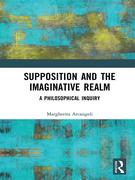
Supposition and the Imaginative Realm
Supposition and the Imaginative Realm - A Philosophical Inquiry: ab 46.49 €- Shop: ebook.de
- Price: 46.49 EUR excl. shipping